Start with the official Tower Rush demo online to understand the controls, three bonus floors and risk settings. The browser version works on Android, iOS and desktop devices without requiring a standalone game download. This is an independent guide covering the rules, RTP, odds and safer-play habits, so you can learn how the game works before you ever place a virtual stake.
Tower Rush Quick Facts
The public Galaxsys page does not publish one universal INR minimum stake, maximum stake or maximum multiplier. These values should be checked in the information panel of the exact version being demonstrated.
What Is Tower Rush?
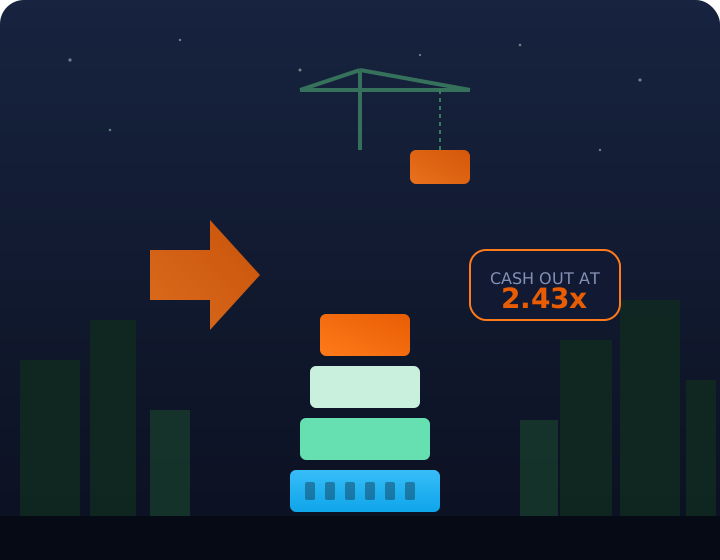
Tower Rush is a Galaxsys tower-building game based on a sequence of separate floor events. The structure begins at its starting level. A successful Build event adds another floor and updates the cumulative value attached to the active attempt.
After every completed floor, you decide what happens next. You can stop and end the sequence or select Build again. Continuing leaves the current tower exposed to another possible collapse.
This repeated decision gives Tower Rush its pace. The rules are simpler than a slot with multiple reels and paylines. There are no card hands to memorise and no opponents to read. The central question remains the same after every success: is the current result enough, or should another floor be requested?
About the Developers of Tower Rush
Galaxsys developed and publishes the original game. The studio operates within the Digitain group and provides fast games, crash titles, table games and other casino products.
The official Galaxsys page currently gives Tower Rush a release date of 28 February 2024. It lists an RTP range of 96.2% to 97.6% and names three bonus features: Frozen Floor, Temple Floor and Triple Build.
These first-party figures are more reliable than statistics copied across unaffiliated websites. If another page displays a different release date, RTP or maximum value, it should identify the specific game configuration supporting the claim.
Tower Rush vs. Crash Games
A traditional crash game places a rising value on a graph. The player watches an aircraft, rocket or line move until the sequence ends.
Tower Rush turns that tension into vertical construction. Instead of watching one uninterrupted curve, you request individual floors. A successful placement creates a visible pause in which the active value can be reviewed.
The current result remains exposed until it is secured, which explains the crash-game comparison. The visual metaphor changes from flight to construction, but continued participation still carries another uncertain outcome.
The Reason Behind Tower Rush's Fast Gameplay
The official provider places Tower Rush within its Fast Games collection and describes it as a Turbo Game in the product details. A new floor can be requested quickly after the previous event resolves. There is no long bonus round or multi-stage reel animation between ordinary decisions.
The speed makes the interface suitable for short demonstrations. It also makes a session limit important because a player can begin another attempt almost immediately after the previous one ends.
The construction animation can make Tower Rush look like an old block-stacking game in which precise timing controls placement. That interpretation is misleading. Galaxsys lists RNG technology and provable fairness among the game's features. The Build control requests the next game event. Tapping at a particular animation point does not reliably force a successful result. The player controls whether another floor is requested; the player does not control the random event that resolves that request.
What Does Open-Ended Construction Mean?
Galaxsys describes the potential number of floors as limitless. No fixed roof is published on the official product page. This does not mean an attempt can easily continue forever. Every additional floor adds another event that must resolve successfully.
The tower can be open-ended in design while very tall sequences remain uncommon. The mathematical challenge comes from completing several uncertain events in succession.
Tower Rush at a Glance
| Attribute | Information |
|---|---|
| Game name | Tower Rush |
| Provider | Galaxsys |
| Parent group | Digitain |
| Release date | 28 February 2024 |
| Provider category | Fast Games and Turbo Games |
| Core mechanic | Open-ended tower construction |
| Official RTP range | 96.2% to 97.6% |
| Theoretical house margin | 2.4% to 3.8% |
| Named bonus floors | 3 |
| Bonus-floor names | Frozen Floor, Temple Floor and Triple Build |
| Maximum tower height | No fixed floor cap stated |
| Fairness technology | RNG and provable fairness |
| Official demo formats | Mobile and desktop |
| Mobile operating systems | Android and iOS through supported browsers |
| Separate game app required | No |
| Supplier licence displayed | MGA/B2B/592/2018 |
The public Galaxsys page does not publish one universal INR minimum stake, maximum stake or maximum multiplier. Check these values in the information panel of the exact version being demonstrated, or open the free demo to see them in context.
The Core Build Loop of Tower Rush
The Tower Rush build loop contains four repeating actions: prepare the attempt, request a floor, review the result and decide whether to continue. For a fuller walkthrough, see the how to play guide.
- Choose a virtual amount. The free demo provides credits that have no monetary value. Select a straightforward amount so that the changing value is easy to calculate. A larger virtual amount increases the displayed result attached to the same game event; it does not make a successful floor more likely. Keep the amount unchanged during the first several attempts.
- Review the risk controls. Some versions may display trap, difficulty or volatility controls. A lower setting may produce steadier progression; a higher setting may create fewer successful stages and larger changes when a floor succeeds. The exact probabilities must come from the current rules. Do not assume that every visible trap represents one equally weighted losing position.
- Press Build. Build requests the next floor and the game resolves the event through its configured system. When the floor succeeds, the structure rises and the cumulative value changes. When it fails, the unprotected sequence ends according to the rules. The animation presents the result; it does not provide a reliable manual timing opportunity.
- Read the updated value. Pause after a successful stage. The updated number represents the active cumulative sequence, not only the most recent floor. This is where Tower Rush differs most clearly from a passive crash animation.
- Cash out or continue. Cash Out ends the sequence at the displayed demo value. Build requests another floor and keeps the current result exposed. Choose a maximum floor count before starting; a predetermined limit is easier to follow than a target created after the tower becomes visually impressive.
Understand the collapse: a collapse ends the active unprotected sequence, and the exact treatment of a protected amount or bonus state belongs to the current rules. Previous successes do not make the next floor safer, and a collapse does not make the next attempt more likely to succeed.
Learn to Play Tower Rush in Simple Steps
- Open the verified game. Start from the official Galaxsys product page or another verified browser demonstration. Check the spelling of the domain. Do not open an APK or private link supplied by a predictor group.
- Check the information panel. Confirm the provider, current RTP, rules and fairness details. This helps identify altered or imitation interfaces. Information shown inside the verified game should override an outdated third-party description.
- Set the virtual amount. Choose a small, easy-to-track demo amount. Virtual credits cannot be deposited, withdrawn or converted into money. Changing the amount does not create a different chance of success unless the rules specifically describe another configuration.
- Select the supported risk lane. If the interface offers trap or difficulty controls, start with the lowest setting. Observe how the displayed values and floor pattern change before testing another lane.
- Request the first floor. Select Build once and allow the event to resolve. Avoid pressing controls repeatedly while the animation is active. A successful floor increases the tower; an unsuccessful result ends the current sequence according to the rules.
- Stop or request another stage. After a successful result, compare the active value with the limit selected before the attempt. Use Cash Out to end the sequence or Build to continue. Do not change the limit simply because the tower appears close to another milestone.
| Step | Action | What Happens |
|---|---|---|
| 1 | Open verified demo | The original browser interface loads |
| 2 | Read game panel | RTP, features and fairness details appear |
| 3 | Choose virtual amount | Starting demo value is set |
| 4 | Select risk control | Supported volatility setting applies |
| 5 | Press Build | One floor event resolves |
| 6 | Stop or continue | Sequence ends, or another floor is requested |
Beginner tip: Use the lowest supported setting, and a maximum of two or three Build decisions while learning the interface. This is a practice limit, not a guaranteed strategy.
Learn How Compounding Values Work
Tower Rush combines successful floor values cumulatively. Multiplication, rather than simple addition, determines the active sequence. Consider an illustrative Rs 100 virtual attempt:
| Stage | Illustrative Floor Value | Calculation | Virtual Result |
|---|---|---|---|
| Start | 1.00 | Rs 100 x 1.00 | Rs 100 |
| Floor 1 | 1.20 | Rs 100 x 1.20 | Rs 120 |
| Floor 2 | 1.40 | Rs 100 x 1.20 x 1.40 | Rs 168 |
| Floor 3 | 1.60 | Rs 100 x 1.20 x 1.40 x 1.60 | Rs 268.80 |
| Floor 4 | 1.80 | Rs 100 x 1.20 x 1.40 x 1.60 x 1.80 | Rs 483.84 |
These values demonstrate the calculation only. They are not an official fixed multiplier sequence. The example shows how exposure grows. Before the fourth floor, the active virtual result is Rs 268.80. Another Build decision exposes that complete amount to the next event.
Adding 1.20, 1.40 and 1.60 would produce 4.20. That is not how cumulative multiplication works. The correct calculation multiplies each stage into the current result. The sequence in the table reaches 2.688 after the third successful floor.
Why a tall tower can feel more valuable than it is: visible progress creates an emotional attachment to the current sequence. A player may feel that completed floors have earned the right to reach the next stage. The game does not owe another success because earlier floors landed. The active sequence remains uncertain until it is ended.
Tower Rush Bonus Floors
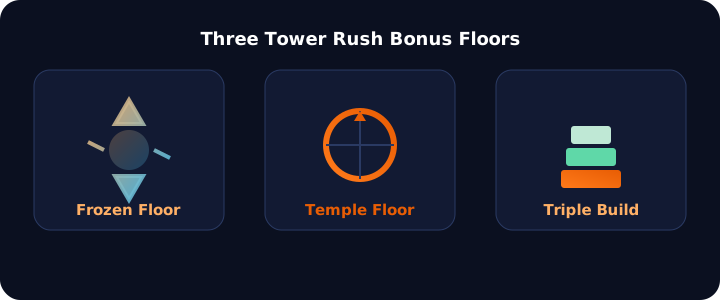
The three named Tower Rush bonus floors distinguish the game from a basic rising multiplier.
Frozen Floor
Frozen Floor introduces a protection-themed state. Where the current rules preserve an active value, the feature can change the consequence of a later collapse. The exact protection must be read carefully. It may preserve a defined amount, stage or checkpoint rather than every future increase. Frozen Floor can make another demo decision feel less exposed. It does not change the next hidden result into a guaranteed success.
Temple Floor
Temple Floor introduces a separate themed bonus event. Some descriptions show it as a segmented roulette or wheel. A wheel with equal-sized visual sections does not necessarily assign equal probability to each outcome. Digital game mathematics can weight the results differently. Use the rules panel to identify the available outcomes and how they affect the active cumulative value. Screen timing does not select a preferred segment.
Triple Build
Triple Build adds several visual floors through a single bonus sequence. The feature accelerates the construction animation, but three visible floors do not automatically mean the value triples. The rules determine whether the feature uses linked values, one combined event or another calculation. Pause when Triple Build ends. Read the updated result before making another decision.
Can more than one bonus appear? Bonus behaviour depends on the current game configuration. Do not assume that a previous feature blocks or guarantees another unless the rules state it. A short personal sample cannot establish the true feature frequency.
Can bonus floors be predicted? No verified tapping pattern, amount sequence or time of day forces a bonus feature. Continuing until a particular floor appears can turn a planned demo session into a chase. Use a fixed session limit instead.
Tower Rush RTP
The official Tower Rush RTP range published by Galaxsys is 96.2% to 97.6%. RTP means return to player. It describes long-run theoretical game behaviour across a very large number of resolved stakes.
| RTP Configuration | Theoretical House Margin |
|---|---|
| 96.2% | 3.8% |
| 96.4% | 3.6% |
| 96.6% | 3.4% |
| 96.8% | 3.2% |
| 97.0% | 3.0% |
| 97.2% | 2.8% |
| 97.4% | 2.6% |
| 97.6% | 2.4% |
The margin is built into the relationship between probability and return. It is not displayed as a separate charge after every attempt.
RTP is not a Rs 100 promise. An RTP of 97% does not mean that Rs 100 always becomes Rs 97. One short session could finish above the starting value; another could end substantially below it. Both can occur while the underlying long-term model remains unchanged.
Why Galaxsys publishes a range: a range indicates that more than one approved mathematical configuration may exist. The public product page does not assign each RTP value to a named trap setting. Check the active game panel rather than assuming every version uses 97.6%.
Can demo results confirm RTP? No. A few dozen or a few hundred virtual attempts are too small to measure a long-run percentage reliably. Random variation dominates short samples. A winning streak does not prove that the RTP is higher than published.
Tower Rush Odds and Probability
Cumulative probability explains why several successful floors are harder to complete than one isolated stage. The following table uses a simplified model containing three equally weighted positions. It should only be treated as official Tower Rush mathematics if the live rules confirm the same structure.
| Simplified Model | Success Per Floor | Two Successes | Three Successes | Five Successes |
|---|---|---|---|---|
| Two successful positions from three | 66.67% | 44.44% | 29.63% | 13.17% |
| One successful position from three | 33.33% | 11.11% | 3.70% | 0.41% |
How cumulative success is calculated: at a hypothetical 66.67% success rate, two successful stages require 0.6667 x 0.6667 = approximately 44.44%. Five successful stages require multiplying the same probability five times, producing approximately 13.17%.
Why three-trap percentages should not be invented: some pages assign an exact success rate to three traps without publishing the number or weighting of available positions. An exact probability requires a complete mathematical model. If the game panel does not disclose it, describe the setting as high volatility without fabricating a percentage.
Does one collapse improve the next attempt? No. An independent random system does not increase the next probability to compensate for an earlier result. The belief that success becomes due after repeated failures is the gambler's fallacy.
Provably Fair Technology
Galaxsys lists provable fairness as a Tower Rush feature. A provably fair process can use cryptographic commitments to help establish that result data was not changed after an event began. Common systems use a server seed, client seed, nonce and cryptographic hash. The actual Tower Rush process should be followed through its own verification panel.
What provably fair does not mean: it does not guarantee profit, remove the mathematical margin or reveal the next result. Verification examines completed events; prediction claims concern events that have not yet resolved.
Why a predictor cannot use the verification hash: a hash is designed to commit to hidden data without revealing that data. A predictor displaying random multipliers does not become legitimate merely because it mentions SHA-256, seeds or artificial intelligence.
Tower Rush Strategies and Session Styles
No Tower Rush strategy can guarantee successful floors. A useful strategy controls behaviour, time and exposure.
- Turtle session: Uses the lowest supported setting and an early stopping rule. Its purpose is to observe more completed stages with smaller virtual-value changes. A target such as 1.5x or 2x is not guaranteed; it only describes an intended exit point.
- Moderate session: Allows more floors but uses a fixed stage cap selected before the attempt. This creates stronger variation than the Turtle approach and requires greater discipline because the tower may continue growing near the chosen limit.
- Aggressive observation: Uses the highest supported risk lane for a short, separate test. The purpose is to understand sharp volatility, not to recover losses or produce a target result. End the session when the attempt cap is reached, even if the last tower appeared close to a major increase.
| Session Style | Target Structure | Risk Setting | Primary Rule |
|---|---|---|---|
| Turtle | Early exit | Lowest supported | Stop after a small fixed number of floors |
| Moderate | Mid-level tower | Low or medium | Use a predetermined floor cap |
| Aggressive observation | Short high-volatility test | Highest supported | Separate attempt and time limit |
Use a fixed virtual percentage: during demo practice, use between 1% and 2% of the virtual session balance per attempt. This keeps enough credits available to inspect several sequences. It is not a real-money recommendation or a method for overcoming the house margin.
Avoid Martingale. Martingale doubles the amount after every loss, and the progression grows exponentially.
| Attempt | Starting at Rs 10 |
|---|---|
| 1 | Rs 10 |
| 2 | Rs 20 |
| 3 | Rs 40 |
| 4 | Rs 80 |
| 5 | Rs 160 |
| 6 | Rs 320 |
| 7 | Rs 640 |
| 8 | Rs 1,280 |
| 9 | Rs 2,560 |
| 10 | Rs 5,120 |
After ten attempts, the required amount is 512 times the original Rs 10. No future success is guaranteed to arrive before the balance or platform limit is reached.
Use automatic cash out as a rule tool: if a verified version provides auto cash-out, it can execute a predetermined target. It does not improve the probability of reaching that target. The tower can collapse before the instruction becomes active.
Play Tower Rush Demo Online
The Tower Rush demo online uses virtual credits and allows you to explore the original interface without a monetary deposit. Open the free demo to try the loop for yourself.
What the demo includes: the central floor-building loop, cumulative values and available bonus features. It also allows you to locate the game information and fairness controls before beginning an attempt.
No download is required. The provider demonstration uses browser technology and can run in current versions of Chrome, Safari and Edge. This makes Tower Rush free play available on Android phones, iPhones, tablets, laptops and desktop computers.
No registration for basic product exploration: the official provider demo can be opened without creating a real-money casino account. A platform may place its own account layer around a game, but that is separate from the core Galaxsys demo.
A 30-attempt practice plan:
- Attempts 1 to 10. Understand Build and Cash Out.
- Attempts 11 to 20. Compare supported settings while keeping the virtual amount constant.
- Attempts 21 to 30. Practise one predetermined stopping rule.
End after the thirtieth attempt. Do not extend the session simply because a bonus feature has not appeared. What the demo cannot prove: virtual profits cannot be withdrawn, so they do not demonstrate that a system produces income. A short demo sample also cannot verify exact RTP or bonus frequency.
Tower Rush for Players in India
For Indian users, the official Galaxsys demo is the appropriate route for learning the product.
- Verify the game provider. Confirm that Galaxsys appears in the information panel. A copied logo elsewhere on a website is not enough. Compare the interface with the official Galaxsys product gallery.
- Inspect the rules before using the game. The rules should identify RTP, feature behaviour and fairness information. A page that hides these details while emphasising deposits deserves caution.
- Understand the current Indian legal position. India's Promotion and Regulation of Online Gaming Act, 2025 came into force on 1 May 2026. The national law prohibits online money games, advertising for those games and related fund transfers. It also applies to offshore services offered within India. For that reason, this website provides demo, mechanics and safety information rather than real-money operator links.
- Do not treat technical access as permission. A website may remain reachable even when participation in its money games is prohibited. INR display, UPI logos and Indian-language support are localisation features; they do not establish legal authorisation.
- Do not use personal payment accounts. A personal UPI address should never be treated as a verified gaming cashier. Do not send another payment to unlock a withdrawal, complete tax verification or activate a bonus.
| What to Inspect | Why It Matters | Warning Sign |
|---|---|---|
| Provider attribution | Confirms the game identity | Galaxsys is missing |
| Information panel | Shows RTP and rules | Panel cannot be opened |
| Fairness controls | Supports result verification | Guaranteed prediction claim |
| Website identity | Helps detect imitation domains | Misspellings or shortened links |
| Device permissions | Protects private data | Requests SMS or accessibility access |
| Money claims | Reveals misleading marketing | Fixed income or guaranteed withdrawal |
This checklist verifies product information. It does not turn an offshore money service into a lawful option for Indian users. See our guidance on online casinos for more on spotting safe interfaces.
Tower Rush on Mobile
Why the vertical design fits a phone: the tower grows upward, matching the shape of a portrait phone display. The current value and primary controls can remain visible below the structure without requiring a wide graph.
Android browser access: open the provider demo through an updated version of Chrome or another current browser. No Tower Rush game download is required for basic access.
iPhone and iPad access: Safari can display the browser demo on supported Apple devices. A home-screen shortcut can provide quick access without installing an unknown package.
Mobile connection quality: a stable connection improves animation and button responsiveness. It does not improve floor probability, RTP or bonus frequency. If the interface becomes unresponsive, close the session rather than pressing Build or Cash Out repeatedly.
Tower Rush APK Safety
There is no need to install an unknown Tower Rush APK for the official demo. An APK can be created and renamed by anyone. A familiar icon does not prove that Galaxsys produced the file. Avoid packages shared through Telegram, WhatsApp, YouTube comments and third-party download sites. Never grant an unknown game access to SMS, contacts, notifications, photos or accessibility services.
Is Tower Rush Real or Fake?
The original Galaxsys Tower Rush real game is genuine and documented on the provider's website. Fake risks appear through clone pages, predictor applications and unofficial downloads.
- Verify Galaxsys. The game information should identify Galaxsys as the provider. An invented developer name or missing company record is a warning sign.
- Verify the product details. The official page publishes a February 2024 release date, RTP range and three bonus-floor names. A clone may copy the visuals while displaying inconsistent product information.
- Verify the domain. Check spelling, HTTPS and the page's relationship with the provider. HTTPS protects data in transit; it does not independently prove that a website operator is trustworthy.
- Verify licence claims. Galaxsys displays Malta supplier licence MGA/B2B/592/2018. A third-party website cannot prove its own status by copying the supplier's number. Licence details must match the correct entity and domain.
Tower Rush Predictor and Scam Warning
No Tower Rush predictor can guarantee the next floor.
Fake predictors generate many guesses, then highlight correct ones and delete the failures, so a selected screenshot never shows the full history. Signal-group admins send different predictions to separate groups and later reuse the successful message as proof. Premium signals give no access to hidden RNG inputs, and a fake earning app may show a growing balance then demand a fee (called tax, KYC, insurance, activation or upgrade) when you try to withdraw. Do not send another payment. Save the evidence and report the incident to cybercrime.gov.in or call 1930.
Responsible Gaming
Set limits before the first floor and use Tower Rush as entertainment and product education, never as income. Visit our responsible gambling page for more support tools.
- Set a time limit. Choose the session duration before opening the demo. A useful practice window is 15 to 20 minutes. Stop when the timer ends, even if the current attempt has just produced an exciting result.
- Set an attempt limit. Decide how many virtual attempts will be used. Twenty or thirty attempts are sufficient for understanding the interface. Do not continue indefinitely until a specific bonus appears.
- Choose a stop point. Set the maximum number of floors before each attempt. Do not move the limit because the tower appears close to another milestone.
- Use a cooldown. Take at least 15 minutes away from the game after frustration or an unplanned extension. A cooldown interrupts the rapid Build-again cycle.
| Responsible Limit | When to Set It | Example |
|---|---|---|
| Time limit | Before opening the demo | 15 minutes |
| Attempt limit | Before first Build | 20 attempts |
| Floor limit | Before each sequence | Fixed stage cap |
| Cooldown | After frustration | At least 15 minutes |
| Stop condition | Before starting | First reached limit |
Treat Tower Rush as entertainment, never as income. If play causes anxiety, secrecy, debt or conflict, stop and reach out for support. In India, Tele-MANAS is available at 14416 or 1800-89-14416, and 112 is the emergency number. You can also contact a recognised support organisation such as Gambling Therapy, GamCare or Gamblers Anonymous.
Frequently Asked Questions
What is Tower Rush?
Tower Rush is a Galaxsys tower-building game. Each completed floor changes a cumulative value, after which the player can stop or request another stage.
Who made Tower Rush?
Galaxsys developed and publishes the original product. The studio operates within the Digitain group.
When was Tower Rush released?
The official Galaxsys page lists 28 February 2024 as the release date.
What is the Tower Rush RTP?
The official range is 96.2% to 97.6%. Check the active information panel for the configured value.
Can I play Tower Rush for free?
Yes. The Galaxsys demo uses virtual credits and does not require a monetary deposit.
Does the demo use real money?
No. Demo credits have no cash value and cannot be withdrawn.
Is Tower Rush like roulette?
No. Roulette uses numbered wheel outcomes. Tower Rush uses successive tower-floor events and cumulative values.
How many bonus floors are there?
Galaxsys names three: Frozen Floor, Temple Floor and Triple Build.
Is Tower Rush provably fair?
Galaxsys lists provable fairness as a product feature. Follow the current game panel for the exact verification process.
Does provably fair mean predictable?
No. It supports verification of completed events. It does not reveal the next hidden result.
What is the minimum Tower Rush bet in India?
The public provider page does not publish one universal INR minimum. Limits can depend on the implementation, so check the active game panel.
Does Tower Rush require an app?
No. The official demo works through supported mobile and desktop browsers.
Can I use Tower Rush on Android?
Yes. Open the verified mobile demo in Chrome or another updated Android browser.
Can I play on an iPhone?
Yes. The mobile browser demo can run through Safari on supported iPhones and iPads.
Do Tower Rush predictors work?
No external tool can guarantee future RNG results. Selected screenshots and deleted predictions do not prove accuracy.
Is Tower Rush real or fake?
The original Galaxsys product is real. Clone websites, unofficial APK files and predictor applications may be fraudulent.
Does a taller tower make the next floor safer?
No. Tower height shows previous successful stages. It does not reveal or improve the next unresolved result.
Can I control the floor through timing?
No verified timing technique can force a successful RNG result. The construction animation displays the event.
Can I use Martingale in Tower Rush?
Martingale cannot guarantee recovery. The required amount grows exponentially, and no future floor is guaranteed to succeed before the balance limit is reached.
Is Tower Rush legal for real-money play in India?
India's national prohibition on online money games took effect on 1 May 2026. Indian users should use the free demo rather than offshore money services.
Play the Tower Rush Game Online With Virtual Credits
Explore the original Galaxsys interface, learn how cumulative values work and inspect every bonus feature without installing an unknown application. Read more in our FAQs or jump straight into the practice loop.
Independent Website Disclosure
This website is an independent Tower Rush information resource. It does not operate a casino, advertise online money games, accept deposits, process withdrawals or guarantee results. Tower Rush, Galaxsys and associated product names belong to their respective owners. Confirm current details through the official Galaxsys page and the active game information panel.
Last reviewed: July 2026
